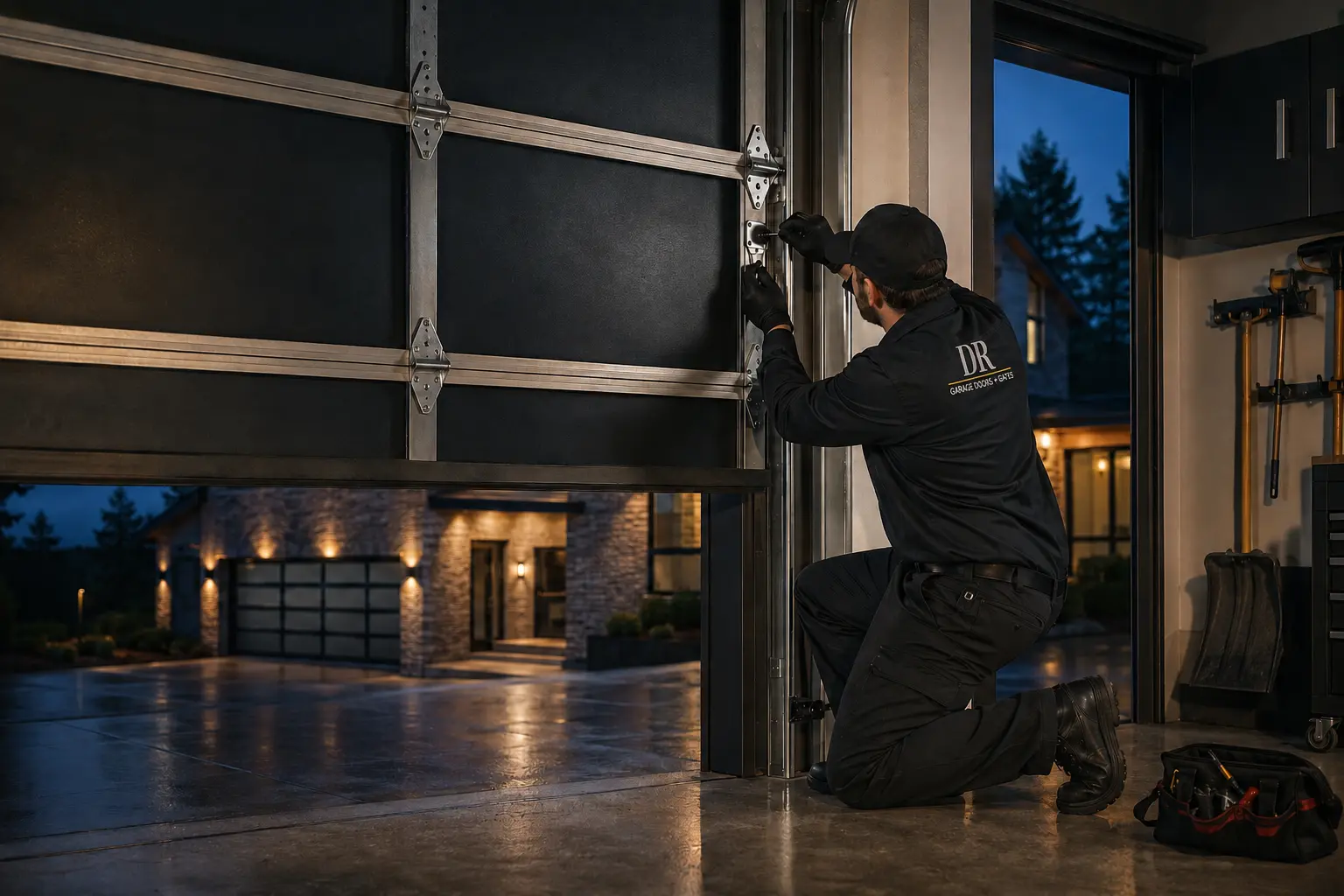
A garage door that stops halfway is often meeting abnormal weight or resistance. Stop repeated opener attempts and note whether the door is level, crooked, noisy or supported unevenly.
First check whether the door is level
A level door that stops at the same point may be binding in the track, meeting a damaged roller or reaching an opener travel problem. A crooked door points more strongly toward uneven cable tension, an off-drum cable or resistance on one side.
Do not stand beneath a partly open door. Keep people and vehicles away and do not loosen the bottom brackets, drums or spring hardware.
What the halfway stop can point to
| What you notice | Possible system to inspect |
|---|---|
| The door is level and stops at the same point | A damaged roller, bent track section or opener travel problem |
| The door is crooked or one side sits lower | Uneven cable tension, a cable off the drum or a roller outside the track |
| The motor hums or clicks but the door barely moves | A broken or weak spring, opener drive or trolley problem |
| The door rises and drops or feels unusually heavy | A counterbalance or spring-system fault |
| The door closes partway and reverses | An obstruction, sensor issue, excess resistance or travel setting |
These are clues, not a remote diagnosis. A partly open or crooked door can move suddenly, so leave loaded hardware untouched.
The opener may not be the original problem
An opener is designed to move a balanced door. When a spring loses force or a roller binds, the opener may stop to protect itself or continue straining until another part fails.
Repeated button presses can turn a door problem into trolley, gear or drive damage. Record what the motor does, then stop cycling the system.
Look without touching loaded hardware
From a safe distance, look for a visible spring gap, a loose cable, a roller outside the track, a bent rail or an object in the travel path. A full-door photo helps show whether one side is leading the other.
What a repair diagnosis covers
The inspection should separate counterbalance, cable and travel faults from opener and control faults. Balance, both cable paths, rollers, tracks, hinges, opener connection and safe travel are considered together.